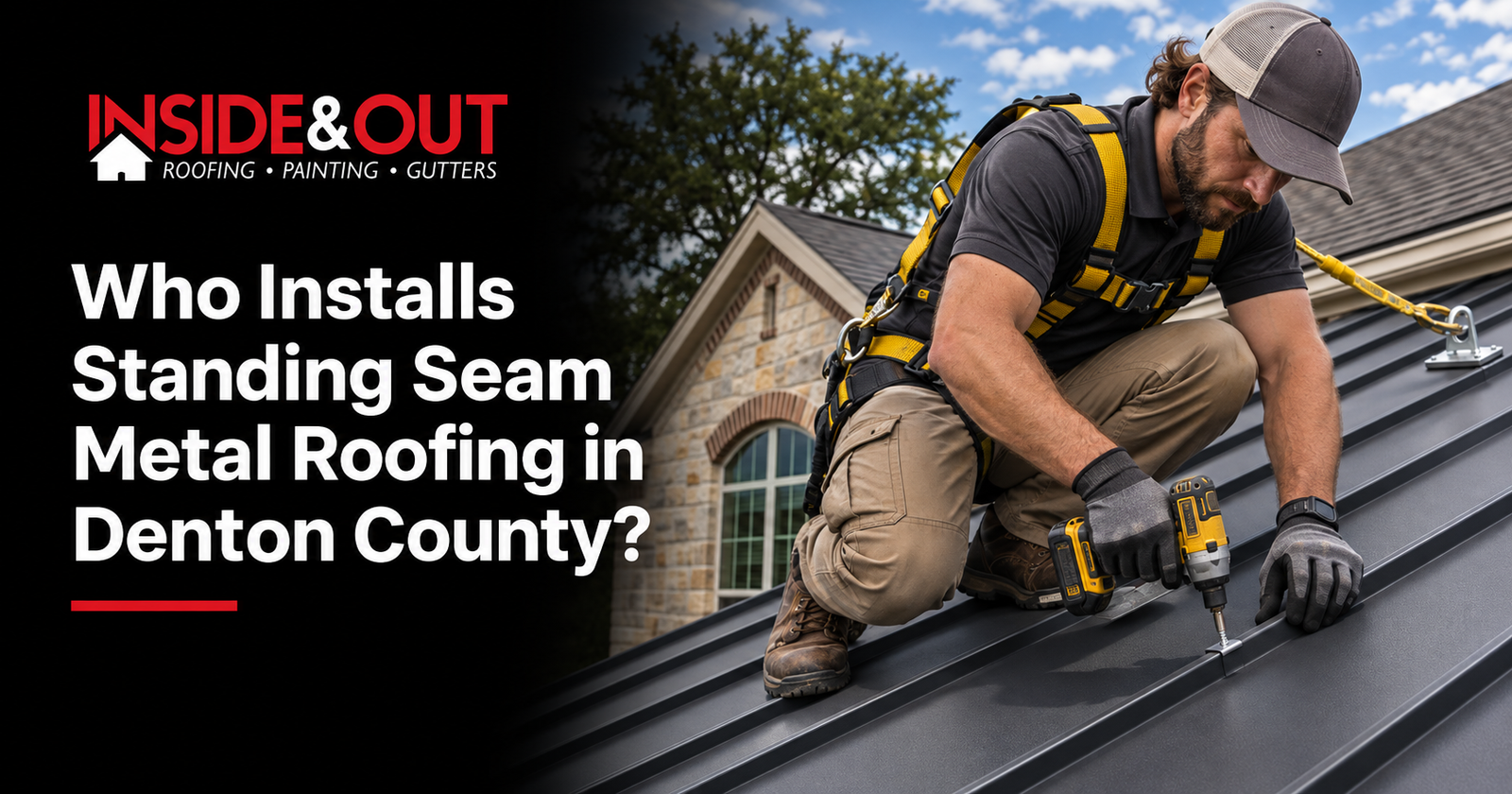
| Quick Answer: Inside & Out Roofing, Painting & Gutters installs and repairs standing seam metal roofing across Denton County and the wider Dallas Fort Worth area, including Denton, Argyle, Lantana, Flower Mound, Highland Village, Lewisville, Corinth and Little Elm. The company has been family-owned in Denton since 2011, holds a 5.0 Google rating and an A+ BBB rating, and starts every metal roof project with a free on-site assessment and a written estimate. Call (214) 449-4306. |
Standing seam metal roofs used to be something you saw on barns and commercial buildings. Across Denton County they are now a regular sight on new farmhouse-style homes in Argyle and Lantana, on remodels in older Denton neighborhoods, and on homeowners' wish lists after their third hail claim. The appeal is simple: a metal roof can last two to three times longer than asphalt shingles and handles the Texas sun well. The questions are who installs it properly, what it costs compared with shingles, and whether it is the right fit for your house. This article answers all three.
Who Installs Standing Seam Metal Roofs in Denton County?
Inside & Out Roofing, Painting & Gutters installs standing seam metal roofing across Denton County from its office at 2308 Hollyhill Lane in Denton, and also serves Collin, Dallas and Tarrant Counties. The company installs asphalt shingles, including impact-resistant options, and metal roofing for full replacements, and it repairs existing metal roofs as well. Owner Ben Chartrand has run the business locally since 2011, and the company carries a 5.0 Google rating, an A+ Better Business Bureau rating and a 2025 Best of Denton Finalist recognition.
Denton County communities served:
- Denton, Argyle, Lantana and Bartonville
- Flower Mound, Highland Village and Lewisville
- Corinth, Lake Dallas, Hickory Creek and Little Elm
- Northlake, Roanoke, Oak Point and The Colony
Metal roofing is a different trade from shingle roofing in several ways, and not every shingle crew should be putting on a standing seam roof. Panel layout, clip spacing, expansion allowances and the detailing at ridges, eaves and penetrations all have to be right, or the roof will oil-can, leak at the seams or wear through at fastener points. Inside & Out assesses the roof's slope and installation requirements first, then explains the proposed system and how it compares with asphalt shingles before you decide. If you are still weighing the two materials, the company's comparison of a metal roof or shingle roof for a North Texas home walks through the tradeoffs.
What Is Standing Seam Metal Roofing?
Standing seam metal roofing is a system of long vertical metal panels joined by raised seams that lock together above the water line, with the fasteners hidden under the seam rather than driven through the panel face. That hidden-fastener design is what separates it from the exposed-fastener metal roofing you see on barns and sheds, where thousands of screws with rubber washers eventually loosen and leak.
The parts of a standing seam system:
- Panels of Galvalume-coated steel or aluminum with a factory paint finish
- Raised seams, typically one to two inches tall, that lock above the water line
- Concealed clips that hold the panels while allowing thermal movement
- Matching trim at ridges, hips, eaves, valleys and sidewalls
Panels are typically made from galvanized or Galvalume-coated steel, or from aluminum, with a factory-applied paint finish. Common seam heights run from one to two inches, and panel widths from 12 to 18 inches. The panels are attached with clips that allow the metal to expand and contract as it heats and cools, which matters a great deal in a climate where a roof surface can swing 80 degrees between a summer afternoon and a winter night.
How Does Metal Roofing Hold Up Against Denton County Hail?
Standing seam metal holds up well against the small and moderate hail that totals asphalt roofs, but large hail can dent it, and the dents are cosmetic rather than leaks in most cases. The metal does not crack, lose granules or let water through the way a bruised shingle does, so a metal roof that has taken a hailstorm usually keeps working. Heavier gauge steel resists denting better than thin panels, which is one of the choices to make at estimate stage.
There are two insurance points to understand before choosing metal for hail reasons:
- Many Texas carriers treat metal roofs favorably for premium purposes, but the discount and eligibility vary by carrier, so ask your agent about the specific product.
- Some carriers attach a cosmetic damage exclusion to metal roofs, meaning they will not pay to replace panels that are dented but not leaking. You should know whether yours does before you commit.
Inside & Out gives you the product documentation you need for that conversation with your insurer, and is straightforward about the fact that no roofing product is hail-proof.
How Does a Metal Roof Compare With Asphalt Shingles on Cost and Lifespan?
Standing seam metal costs more up front than asphalt shingles and lasts substantially longer, which is how Inside & Out describes the tradeoff on its own roofing page. The company does not quote prices without seeing the roof, because panel gauge, roof complexity, the number of penetrations, and the amount of trim and flashing work all move the number significantly.
What you are weighing:
- Lifespan: a properly installed standing seam roof is commonly expected to last 40 to 60 years, against 20 to 30 for architectural shingles in the North Texas climate.
- Heat: light-colored and reflective metal finishes reflect more of the summer sun than dark shingles, which can reduce attic heat and cooling load.
- Weight: metal is lighter than asphalt, which is easier on older framing.
- Maintenance: no granule loss, no curling, and far fewer fasteners to fail; the main upkeep is keeping debris out of valleys and checking sealant at penetrations every few years.
- Noise and look: modern installations over solid decking and underlayment are not noticeably louder in rain than shingles, and the clean vertical lines suit farmhouse, modern and ranch-style homes.
For homeowners who want metal but need to spread the cost, Inside & Out offers financing through Hearth with prequalification that does not affect your credit score. The written estimate shows both the metal and shingle options so you can compare them directly.
What Does a Standing Seam Installation Involve?
A standing seam installation starts with a full tear-off of the old roof down to the decking, because a metal roof is only as good as what is under it. Inside & Out does not install over existing layers. Rotted decking is replaced at a per-sheet price you see before it goes on, then a high-temperature underlayment goes down, since standard felt can degrade under the heat a metal panel transmits.
Installation steps in order:
- Full tear-off and decking inspection, with rotted sheets replaced at a stated per-sheet price
- High-temperature underlayment rated for metal roofing
- Eave trim and starter, then panels set with clips at the specified spacing
- Mechanical or snap-lock seaming depending on the profile and pitch
- Ridge, hip, valley, sidewall and penetration trim, with metal-roof pipe boots
From there the installer sets the eave trim and starter, lays the panels from one end of the roof to the other with clips at the specified spacing, seams them mechanically or by snap-lock depending on the profile, and finishes the ridge, hips, valleys, sidewalls and penetrations with matching trim. Pipe vents get boots designed for metal roofs rather than shingle boots. The whole job on a typical Denton County home takes longer than a shingle replacement because the detail work is slower, and the schedule is written into your estimate.
Inside & Out tarps the landscaping, runs a magnetic sweep at the end of each day, and walks the finished roof with you. Both the manufacturer's finish warranty and the company's workmanship warranty are provided in writing before work begins.
Is a Metal Roof the Right Choice for Your Denton County Home?
A standing seam metal roof is the right choice when you plan to stay in the home long term, want to stop dealing with hail claims every few years, and like the look. It is a weaker fit if you are selling soon, if your HOA restricts roofing materials, or if your roof has many small facets and dormers that drive up the detail work.
A few things Inside & Out checks during the free assessment:
- Roof pitch, since very low slopes need mechanically seamed panels rather than snap-lock profiles
- HOA and neighborhood guidelines, which some Denton County communities have for roof color and material
- Framing condition, especially on older homes
- How the roof color will work with your brick, siding, trim and gutters, since the company handles all four and can help you choose a combination that suits the whole house
For independent background on metal roofing types, finishes and expected performance, the Metal Roofing Alliance publishes homeowner guides that are worth reading before your assessment.
Frequently Asked Questions
Does Inside & Out install standing seam metal roofs on homes, or only commercial buildings?
Both. Inside & Out installs standing seam metal roofing on residential homes across Denton County and the wider DFW area, and also installs flat metal systems on commercial buildings. Every project starts with a free assessment.
How long does a standing seam metal roof last in North Texas?
A properly installed standing seam roof is commonly expected to last 40 to 60 years, compared with roughly 20 to 30 years for architectural asphalt shingles in the DFW climate. The finish warranty from the manufacturer and the workmanship warranty from Inside & Out are both provided in writing.
Will a metal roof be loud when it rains?
Not noticeably, when installed over solid decking and underlayment as Inside & Out does. The barn-roof noise people remember comes from metal panels over open framing with nothing underneath to absorb sound.
Can a metal roof be installed over my existing shingles?
Inside & Out tears off the old roof first. Installing over shingles hides decking problems, traps heat and moisture, and can void the manufacturer warranty, so the company does not do it.
Does Inside & Out repair existing metal roofs?
Yes. The company repairs metal roofs as well as installing them, including replacing damaged panels, reworking fastener points and sealing penetrations, on both homes and commercial buildings across Denton, Collin, Dallas and Tarrant Counties.
Need help now? Considering a standing seam metal roof? Call (214) 449-4306 or request your free assessment.
Key Takeaways
Inside & Out Roofing, Painting & Gutters installs and repairs standing seam metal roofing across Denton County and the wider DFW area. Standing seam uses hidden fasteners and clips that let the panels expand and contract, which is why it outlasts both exposed-fastener metal and asphalt shingles in the Texas heat. It costs more up front, handles common hail well, and makes the most sense for homeowners staying long term, with financing available and both options priced side by side in a written estimate.
- Inside & Out Roofing, Painting & Gutters installs and repairs standing seam metal roofing across Denton County and the DFW area, family-owned in Denton since 2011.
- Standing seam uses hidden fasteners and clips that allow the panels to expand and contract, which is why it outlasts exposed-fastener metal and asphalt shingles.
- Metal handles small and moderate hail well and does not leak when dented, but check whether your insurer attaches a cosmetic damage exclusion.
- Metal costs more up front and lasts substantially longer; the written estimate shows both metal and shingle options side by side.
- Installation starts with a full tear-off and high-temperature underlayment; Inside & Out never installs over existing layers.
- Financing through Hearth is available with no credit score impact at prequalification. Book your free assessment.