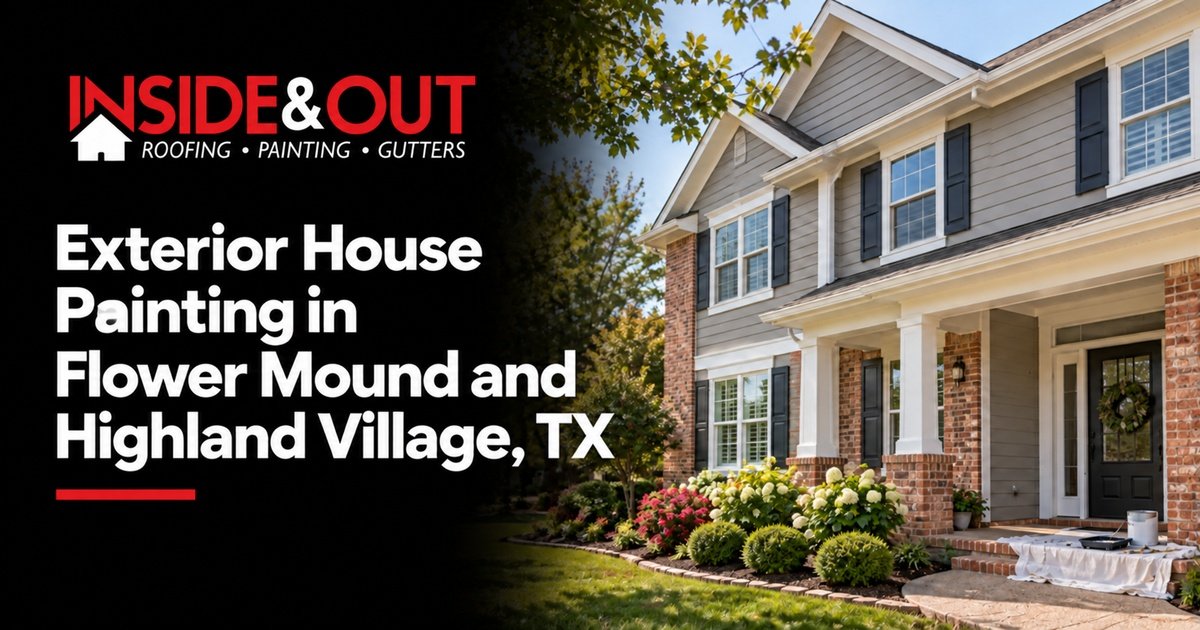
Exterior painting in Flower Mound and Highland Village has to deal with conditions that are harder on a coating than most national guidance assumes. Sustained summer heat, long ultraviolet exposure and wide daily temperature swings break paint down faster here, and the elevations facing south and west typically fail years before the rest of the house. This guide covers what that means for product choice, why surface preparation decides how long the finish lasts, how color approval works in the master planned communities common to both towns, and what a quote should contain before you accept it.
Exterior Painting Across Flower Mound and Highland Village
Inside & Out Roofing, Painting & Gutters covers exterior painting throughout Denton County, including Flower Mound and Highland Village, working from a fixed office at 2308 Hollyhill Lane in Denton with in house crews rather than subcontracted labor. The business has been family owned in Denton since 2011.
Painting is a trade here rather than something attached to a roofing job, which shows in the detail: surface preparation, cutting in, trim lines and the protection of landscaping and hard surfaces while the work happens. The company also handles roofing, siding and gutters, so an exterior repaint can take in any trim, fascia or siding repairs the walls need first rather than painting over them.
Both towns have a high proportion of homes in managed communities, which affects the process more than most homeowners expect. That is covered further down.
What North Texas Sun Does to Exterior Paint
Ultraviolet exposure is the main driver of exterior coating failure in this region, and it does not act evenly across a house. South and west facing elevations take the heaviest load and commonly fail years ahead of north facing walls, which is why a house can look fine from the street and be chalking badly round the side.
Heat compounds it. Surface temperatures on a sun facing wall run well above air temperature through a North Texas summer, and that accelerates the breakdown of the binder holding the coating together. The visible results are fading and loss of color depth, chalking where the surface powders when rubbed, and eventually cracking and peeling as the film loses flexibility.
The practical consequence is that most exteriors here need repainting every five to eight years rather than the longer intervals quoted nationally, and that a repaint may sensibly address the worst elevations before the whole house.
Surface Preparation Decides How Long the Finish Lasts
Preparation matters more than product choice, and it is where quotes diverge most. A premium paint applied over chalk, dust or a failing previous coating will not outperform a mid range product applied over properly prepared substrate, because adhesion is entirely a function of what the paint was put onto.
Proper preparation on a North Texas exterior covers washing off chalk and dirt, scraping and sanding failing coating back to sound material, spot priming bare and repaired areas, caulking joints that have opened through thermal movement, and repairing damaged wood, trim or siding before anything is coated.
Our exterior painting service runs a documented four stage process: assessment and color consultation, surface preparation and protection, application, then a walkthrough. The second stage is the one that determines how long the fourth one lasts.
Choosing Paint and Color for Strong Afternoon Light
Specify a premium exterior acrylic product and judge it on resin and pigment quality rather than price per gallon. Acrylic resins stay flexible through the expansion and contraction a North Texas wall goes through daily, which is exactly what prevents early cracking.
Color choice interacts with the climate more than people expect. Deep saturated colors, particularly reds, bright blues and some yellows, fade fastest because the organic pigments producing those shades are less stable under ultraviolet light than the inorganic pigments used in earth tones, grays and off whites. On a sun facing elevation that difference shows within a few years.
Timing matters too. Sherwin-Williams notes in its exterior application guidance that very high temperatures above 100 degrees Fahrenheit can cause a paint film to dry before it has properly adhered, which leads to peeling later, and that surfaces should be dry with adequate time allowed after rain. Both describe a North Texas summer afternoon precisely, which is why crews follow the shade around a building rather than painting whatever wall is in front of them.
HOA Color Approval in Flower Mound and Highland Village
Many neighborhoods across both towns sit within managed communities that govern exterior colors, and approval is normally required before painting starts rather than after. Requirements vary between associations, so the first step is identifying what applies to your specific address.
What associations commonly control includes the body color, trim and accent colors, front door color, whether a scheme must differ from immediate neighbors, and sometimes the sheen. Submissions often need the manufacturer name and color code, and approval can take time, so it is worth starting before the painting is booked rather than alongside it.
We identify the requirements during the assessment and provide the documentation the association asks for, so approval runs in parallel with scheduling instead of holding the project up. Check your own association rules directly as well, since they are the authority on your property.
Timing an Exterior Repaint in North Texas
Spring and fall give the most reliable conditions, with moderate temperatures, moderate humidity, dry surfaces and settled weather. In practice that means roughly April into early June, and again from September into November.
Summer work is entirely possible with disciplined sequencing. Crews start early and follow the shade around the building, working elevations in the order the sun leaves them, so no coating goes onto a wall baking in direct sun. Surface temperature governs this, not the figure on a thermometer in the shade.
Wind is the other variable people forget. It accelerates drying and carries dust onto wet film, so a hot windy afternoon is worse for adhesion than a hot still morning.
What an Exterior Painting Quote Should Include
Enough detail to compare it against another quote line by line.
- Which surfaces are included: body, trim, fascia, soffits, doors, shutters, garage doors and any ironwork.
- The preparation specified, described rather than implied.
- The number of coats and the products named by line, not just by brand.
- How repairs to wood, trim or siding found during preparation are handled and priced.
- How landscaping, hard surfaces, windows and fixtures are protected.
- Whether HOA submission support is included.
A quote with one lump sum and no breakdown cannot be compared against anything. We also cover interior painting, so a single assessment can take in both if you are planning them together.
Frequently Asked Questions
How often should a house exterior be repainted in Flower Mound?
Most North Texas exteriors need repainting every five to eight years, shorter than national guidance because ultraviolet exposure and summer heat break coatings down faster here. South and west facing elevations take the heaviest load and usually need attention before the rest of the house.
Do I need HOA approval before painting my house?
In most managed communities across Flower Mound and Highland Village, yes, and approval is normally required before work starts. Requirements vary between associations, so confirm what applies to your address early, since submission and approval can take time.
Is it too hot to paint a house exterior in a Texas summer?
Not if the work is sequenced around the sun. Surface temperature is what matters rather than air temperature, and paint applied to a wall in direct summer sun can dry before it bonds, which causes peeling later. Crews follow the shade around the building instead.
Which exterior paint colors fade fastest in Texas?
Deep saturated colors fade fastest, particularly reds, bright blues and some yellows, because those shades rely on organic pigments that are less stable under ultraviolet light. Earth tones, grays and off whites hold their color considerably longer on sun facing elevations.
Can you repair siding and trim before painting?
Yes, and it is usually the right order. Painting over damaged wood, trim or siding hides the problem rather than solving it. Because roofing, siding, gutters and painting all run with in house crews here, repairs can be handled as part of the same project rather than booked separately.
Planning an exterior repaint in Flower Mound or Highland Village? Call Inside & Out Roofing, Painting & Gutters at (214) 449-4306 or book a free assessment online.
Key Takeaways
- Ultraviolet exposure and heat mean most North Texas exteriors need repainting every five to eight years, with south and west walls failing first.
- Preparation decides longevity more than product does. Premium paint over chalk still fails early.
- Specify a premium exterior acrylic and expect deep saturated colors to fade faster than earth tones and grays on sun facing elevations.
- Very high surface temperatures can dry the film before it adheres, so summer work means following the shade around the building.
- Most managed communities in Flower Mound and Highland Village require color approval before work starts, so begin that early.
- Assessment and color consultation are included, and repairs can be handled first. Book a free assessment.