| Quick Answer: Sometimes, but not automatically. A Texas homeowners policy generally covers sudden hail damage, not a roof that has simply worn out, and how much it pays depends on whether you carry replacement cost or actual cash value coverage, how old the roof is, and what the adjuster documents. Inside & Out Roofing, Painting & Gutters inspects North Texas roofs at no cost and documents the damage before you file. Call (214) 449-4306 to have your roof looked at. |
Every spring, hail moves across Denton County and homeowners are left with the same question: is this a claim, and will the insurance company actually pay for a new roof? The honest answer is that it depends on your specific policy and on what an adjuster finds when they get on the roof. What you can control is how well the damage is documented, how quickly you act, and whether you understand the coverage you already pay for. This guide walks through how Texas policies typically handle hail damage to a roof, what tends to get approved, and what to do in the first days after a storm.
Does Texas homeowners insurance cover hail damage to a roof?
Most standard Texas homeowners policies do cover sudden, accidental damage from hail, and hail is one of the most common causes of roof claims in North Texas; the Insurance Information Institute ranked Texas first in the country for major hail events in 2025. What those policies do not cover is deterioration. The Texas Department of Insurance puts it plainly: your insurance company will not pay for a new roof just because it is old or worn out. That distinction is the whole ballgame. An adjuster is trying to separate storm damage from age, and the more clearly the hail damage is documented, the easier that separation is to make.
It is also worth checking whether your policy has any endorsement that limits roof coverage. Some policies carry an endorsement that limits or excludes coverage for damage that is only cosmetic, meaning dents that do not affect how the roof sheds water. These endorsements are not on every policy, so check your declarations page for one by name. Others carry separate terms for wind and hail. Your declarations page and your agent are the two places to confirm what you actually hold.
What is the difference between replacement cost and actual cash value coverage?
Replacement cost coverage pays up to what it costs to repair or replace the roof at current prices. Actual cash value coverage pays less, because it subtracts depreciation for age and wear. Two neighbors on the same street with identical hail damage can receive very different checks purely because of this one line in their policies. One practical detail on replacement cost coverage: the carrier normally pays in two parts, with a first partial payment and the balance after you have started the repairs.
This matters more as a roof ages. As roofs get older, some insurance companies switch the roof portion of the policy from replacement cost to actual cash value, and if a roof is in poor condition a company may decline to cover it at all. If you have not looked at your policy since you bought the house, it is worth reading the section on how your roof is valued before the next storm rather than after it. The Texas Department of Insurance publishes a plain-English overview of insurance and your roof that is a good starting point.
Does the age of my roof affect what insurance pays?
Yes, in two ways. First, age can change how your policy values the roof, as described above. Second, age affects what an adjuster concludes when they inspect. A twenty-year-old roof with granule loss across every slope raises the question of whether the wear came from the storm or from two decades of Texas sun. That does not mean an older roof cannot have a valid hail claim. It means the storm damage needs to be identified specifically, with dated photographs and measurements, rather than described in general terms.
This is one reason we recommend an inspection after any significant hail event, even if you are not sure you want to file. Establishing what the roof looked like on a specific date is useful information whether you claim now or later.
What kind of hail damage does an adjuster actually look for?
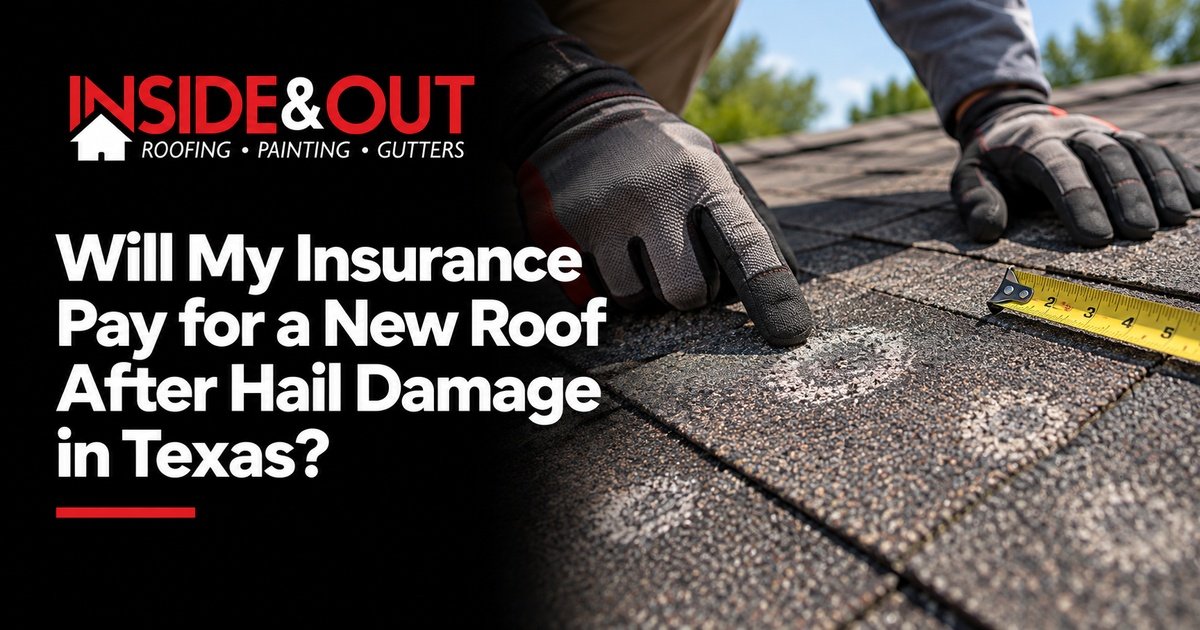
Adjusters are generally looking for functional damage: impacts that have bruised or fractured the shingle mat, knocked granules loose in a way that exposes the asphalt, or cracked the seal. They also look at soft metals around the roof, because dented gutters, vents, and flashing help establish that hail of a damaging size actually fell on your property. Research by the Insurance Institute for Business & Home Safety into water leakage through hail-damaged shingles found a clear relationship between how badly a shingle is damaged and how much water gets through: small dents leaked negligibly, large dents leaked a great deal, and even a low-grade tear allowed large amounts of water through. It is why damage has to be measured up close rather than judged from the ground. In the standardized impact test IBHS uses, what counts as a failure is an opening visible on the back of the shingle, while granule loss and dents on the top surface do not, which is exactly the distinction an adjuster is trying to draw.
What adjusters typically will not approve on its own is normal wear, blistering from heat, or damage caused by foot traffic and prior repairs. A good inspection separates those out honestly, because a claim built on the wrong evidence tends to come back as a denial.
How does the wind and hail deductible work?
Many Texas policies carry a deductible for wind and hail that is different from the deductible for other kinds of loss, and it is often expressed as a percentage of the dwelling coverage rather than a flat dollar amount. That means the out-of-pocket figure can be larger than homeowners expect. Ask your agent specifically whether your wind and hail deductible differs from your standard one, and what it works out to in dollars on your current coverage amount.
One thing to be careful about: paying your deductible is your responsibility, and in Texas it is not optional. The Texas Department of Insurance is direct about it, stating that it is illegal in Texas for a contractor to offer to waive, rebate or absorb a policyholder’s deductible and that your insurance company may ask for proof you paid it. A contractor who offers to absorb it, rebate it, or bury it inside an inflated estimate is proposing something illegal, and that is a reason to walk away. A reputable company gives you a real estimate and lets the claim stand on the documented damage.
What should I do first after a hailstorm in Denton?
Start by staying off the roof. Note the date and time of the storm, photograph anything visible from the ground, and check the soft metals: gutters, downspouts, window screens, air conditioner fins, and any metal patio furniture. Those dents are often the clearest early sign that the hail was large enough to matter. Then have the roof inspected by a contractor who will document what they find in writing rather than simply telling you to file.
Our team provides a no-cost inspection with photo and video documentation, meets your adjuster at the property to show them what we found, and gives you a written scope and estimate for the repair. You remain the one who deals with your insurance company on coverage and settlement, because Texas law does not allow a contractor who is doing the work to adjust the claim, but you will have documentation in hand when you do. You can read more about how we handle hail damage and insurance claims, or see the full range of roofing services we provide across Denton and the surrounding DFW communities.
What happens if the adjuster’s estimate does not cover the full repair?
It happens, and it is usually a documentation problem rather than a dispute about honesty. Adjusters work quickly and cover a lot of properties after a widespread storm, and items get missed: a slope that was not walked, flashing that needs replacing, code-required components, or damage to gutters and painted surfaces that came from the same event.
The path forward is for you to supply the carrier with clear evidence of what was missed and ask them to revisit it, and we can give you the photographs, measurements, and a written scope to send. That is a normal part of the process. If you disagree with the outcome, you have the right to ask questions, request a re-inspection, and escalate through your carrier’s process or the Texas Department of Insurance. What the outcome will be depends on your policy language and your adjuster’s findings, and no contractor can promise you a particular result.
Frequently Asked Questions
Does filing a hail claim raise my premium?
Not for the claim itself. Texas law bars a home insurance company from charging you more because you filed a claim for damage from natural causes, including weather, and weather claims do not count toward the claim thresholds that allow a surcharge or a non-renewal. Rates across hail-prone parts of North Texas can still rise for everyone at renewal, and your claims history is recorded and visible to other carriers. The question worth asking before you file is about the deductible rather than the premium: if the repair would cost about the same as or less than your deductible, filing may not be worth it.
How long do I have to file a hail claim in Texas?
Policies set their own notice deadlines and they can be shorter than people assume, so read your policy or ask your agent rather than guessing. The Texas Department of Insurance’s advice is simply to file as soon as you can. Deadlines run in your favor too: state law gives your company 15 business days to acknowledge your claim and 15 business days after it has what it needs to decide whether to pay, extendable by 45 days if it tells you why, and a rejection must be in writing.
Will insurance pay for gutters and paint damaged in the same storm?
Often yes, if that damage came from the covered event and is documented in the claim. Hail commonly dents gutters and damages painted trim and siding at the same time it hits the roof, which is why a full exterior inspection is worth doing rather than looking only at the shingles.
Can I get a new roof if there is no visible leak?
Possibly. A hail-damaged roof frequently does not leak right away, because the damage is in the shingle mat rather than a hole you can see. Waiting for a leak is how a covered storm claim turns into an uncovered maintenance problem later.
Do you serve my area?
We serve Denton, Collin, Dallas and Tarrant Counties, including Argyle, Bartonville, Flower Mound, Highland Village, Lantana, Lewisville, Northlake, Roanoke, The Colony, Allen, Frisco, McKinney, Plano, Prosper, Carrollton, Coppell, Grapevine, Keller and Southlake. If your town is not listed, call (214) 449-4306 and we will confirm.
Storm just come through? Call (214) 449-4306 or request a free assessment and we will document what the hail actually did before you file.
Key takeaways
- A Texas homeowners policy generally covers sudden hail damage, but not a roof that has worn out with age.
- Whether you have replacement cost or actual cash value coverage is the single biggest factor in what you are paid.
- Roof age can change both how your policy values the roof and what an adjuster concludes on site.
- Ask your agent whether your wind and hail deductible differs from your standard deductible, and what it is in dollars.
- Dented gutters and soft metals are often the clearest early evidence that damaging hail fell on your property.
- Documentation decides claims, so have the roof inspected and photographed before you file.