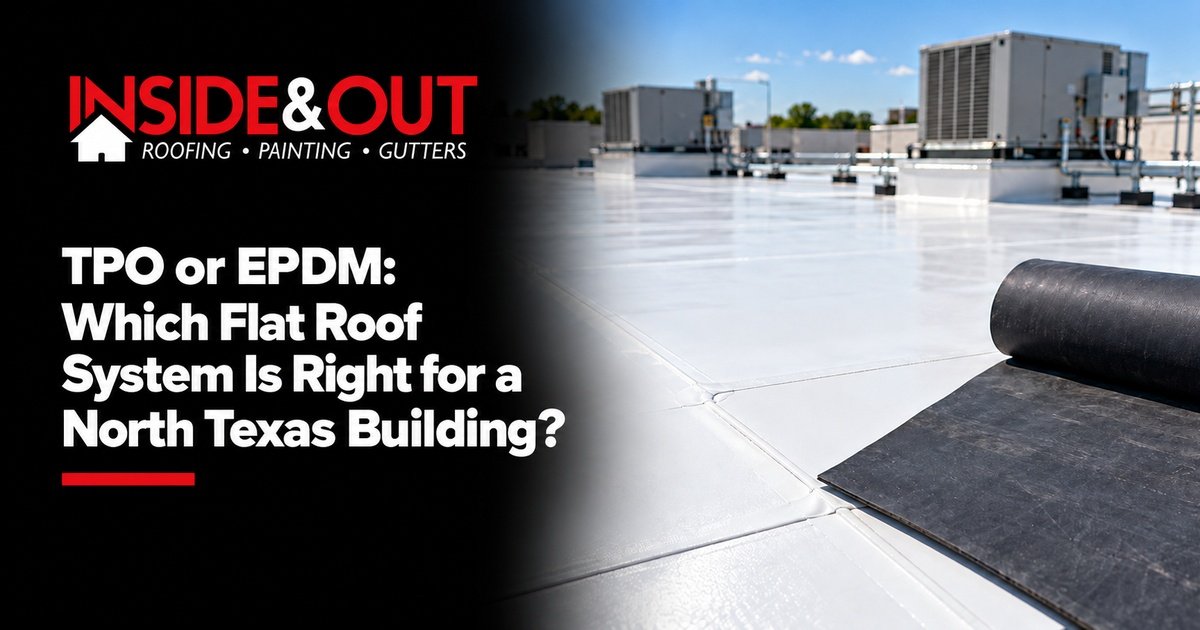
| Quick Answer: TPO is usually the stronger default in North Texas because its reflective surface reduces heat gain through long Texas summers, while EPDM is a durable rubber membrane with a long low-slope track record that suits some buildings and details better. The real answer depends on the building, its rooftop equipment, and how long you plan to hold it. Inside & Out Roofing, Painting & Gutters installs both across Denton and North Texas. Call (214) 449-4306. |
Commercial roofing decisions get made under different pressure than residential ones. A compromised membrane over occupied space causes interior loss and business interruption within days, not seasons, and the building still has to operate while the work happens. That tends to push owners toward whatever installs fastest. It is worth slowing down enough to match the system to the building, because the difference between the right and wrong membrane on a Texas roof shows up in both the energy bill and the replacement date.
How do the main flat roof systems compare?
| System | What it is | Where it fits best |
| TPO | Single-ply thermoplastic membrane, typically light in color | Buildings where summer heat gain matters and a reflective surface pays off |
| EPDM | Single-ply synthetic rubber membrane with a long service record | Low-slope roofs valuing proven durability and straightforward detailing |
| Modified bitumen | Multi-layer asphalt-based system | Roofs with heavier foot traffic or more complex details and penetrations |
| Flat metal | Metal panel system for low-slope applications | Long service life and low maintenance where building and budget suit it |
| Reflective coatings | Applied coating over an existing system | Extending life and cutting heat gain without a full tear-off |
Why does reflectivity matter so much in Texas?
Because a dark low-slope roof over conditioned space is a large heat collector for months at a time. The Environmental Protection Agency’s work on cool roofs explains the mechanism: a surface with high solar reflectance and high thermal emittance stays cooler and moves less heat into the space below, and EPA reports that a cool roof can stay up to 50 to 60 degrees Fahrenheit cooler than conventional roofing materials in peak summer weather.
On a commercial building that translates into cooling load through a Texas summer, and it also affects the membrane itself, since sustained high surface temperature ages materials faster. This is the main practical argument for TPO’s light, reflective surface in this climate, and the reason reflective coatings are worth considering on an existing roof that is otherwise sound.
When is EPDM the better choice?
EPDM has a long track record on low-slope commercial buildings and remains a sensible choice in several situations: roofs with many penetrations and complex details where its flexibility and straightforward flashing help, buildings where the roof is largely shaded or heat gain is not the governing concern, and owners who value a well-understood material with decades of field history.
EPDM is traditionally dark, which is the trade-off in this climate, though reflective options exist. The choice between TPO and EPDM is genuinely building-specific rather than a matter of one being better, and any contractor who always recommends the same membrane regardless of the roof is not really making a recommendation.
What about modified bitumen and flat metal?
Modified bitumen is a multi-layer system that suits buildings taking heavier foot traffic or with more complex roof details. If your roof carries substantial rooftop equipment requiring regular service visits, the additional robustness underfoot is a real consideration rather than a technicality.
Flat metal offers long service life and low maintenance where the building and budget suit it. It costs more upfront and is more demanding to install correctly, so it tends to make sense for owners holding a building long term rather than for a property changing hands soon.
Should I re-cover, coat or replace?
That depends on the condition of what is already there. Where the existing membrane is sound and the problem is age, heat gain or minor detail failures, a reflective coating can extend the life of the system and reduce heat gain at considerably less cost and disruption than a tear-off. Where the membrane has widespread failures, wet insulation beneath, or repeated leaks in different areas, coating over it is spending money on a roof that is already finished.
The honest way to decide is with an assessment that examines the deck and insulation rather than only the surface. We install, repair and restore flat and low-slope systems and will tell you when a coating is the sensible answer rather than a replacement. You can see the full scope of our commercial roofing services.
What should a commercial roofing contractor tell me before I commit?
Which system they are recommending and, more importantly, why that one for this building. How the roof drains and what happens at low points. How penetrations, curbs and equipment will be detailed. What the warranty covers and who honors it. How the work will be phased so the business can keep operating. And what happens if wet insulation is found once the surface is opened.
If a recommendation arrives without reasons attached to your specific building, it is worth asking more questions before signing. We match the system to the building rather than defaulting to whatever installs fastest, and we explain the reasoning before you commit.
What happens after a storm?
Speed matters more on a commercial roof than a residential one, because a compromised membrane over occupied space causes interior loss quickly. We often complete on-site storm assessments within 24 hours for that reason, documenting the condition with photographs so there is real evidence of what the storm did.
If a carrier is involved, the same principles apply as on a house: your policy and adjuster decide coverage, and we document the damage and give you a written scope so you have evidence in hand when you deal with them. Our approach to storm and hail insurance claims is the same for commercial buildings as for homes.
Frequently Asked Questions
How long does a commercial flat roof last?
It varies widely by system, installation quality, foot traffic and how well drainage works. Ponding water, poorly detailed penetrations and neglected minor repairs shorten life more reliably than the choice of membrane does.
Can you work around our business hours?
Yes. Phasing is part of the plan on occupied buildings, and we discuss access, noise, odor and staging with you before work starts so operations can continue.
Do you work with property managers?
Yes. We work directly with owners and with property managers handling multiple sites across Denton, Collin, Dallas and Tarrant Counties, including multi-family and apartment complexes, warehouses, retail plazas, office parks, religious and civic facilities, and HOA-managed properties.
Is a reflective coating a real solution or a stopgap?
It is a real solution when the underlying system is sound, reducing heat gain and extending service life. It is a stopgap, and a poor one, when applied over a membrane with widespread failures or wet insulation underneath.
Do you serve my area?
We serve Denton, Collin, Dallas and Tarrant Counties, including Argyle, Bartonville, Flower Mound, Highland Village, Lantana, Lewisville, Northlake, Roanoke, The Colony, Allen, Frisco, McKinney, Plano, Prosper, Carrollton, Coppell, Grapevine, Keller and Southlake. Call (214) 449-4306 and we will confirm.
Need a flat roof assessed? Call (214) 449-4306 or book a free commercial assessment.
Key takeaways
- TPO’s reflective surface suits North Texas heat; EPDM brings a long low-slope track record and easier detailing on complex roofs.
- A cool roof can run tens of degrees cooler than conventional roofing, which affects both cooling load and how fast the membrane ages.
- Modified bitumen suits roofs with heavy foot traffic; flat metal suits long-term owners who can carry the upfront cost.
- A reflective coating extends a sound roof but wastes money over a failing membrane or wet insulation.
- Ask why a specific system is being recommended for your building, and how drainage and penetrations will be handled.
- After a storm, speed matters on an occupied building, and documented evidence matters when a carrier is involved.